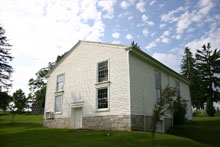
The Flohr House

The Flohr House is a two-story hewn-log dwelling preserved on the grounds of Old St. John Lutheran Church — the home of the congregation’s founding pastor, Rev. Georg Daniel Flohr (1756–1826). Built c. 1807, it is a rare surviving example of early-19th-century clergy housing in southwestern Virginia.

Front elevation of the Flohr House, hewn-log construction with two doors and a central chimney
The Flohr House today, reconstructed on the church grounds in 1984.

The Pastor and the House

Georg Daniel Flohr emigrated from Germany and served as a Revolutionary War private before organizing the scattered German Lutheran families of Wythe County into Old St. John Lutheran Church in 1799. He served the congregation for twenty-seven years, until his death in 1826. He is buried in the church cemetery; his tomb was carved by Laurence Krone.

The house was not originally on this site. It stood on a 47-acre tract Flohr purchased in Wythe County, where he lived, wrote, and preached. For more than 150 years after his death, the house remained on its original site, gradually deteriorating.

Saved Log by Log: The 1984 Preservation

By the early 1980s, the Flohr House was scheduled for demolition. Everett Kegley organized its rescue.

What makes this preservation extraordinary is how it was done: the house was disassembled in place, log by log. Each log was fastened with a numbered aluminum tag so the volunteer team could reassemble the structure correctly on its new site. The house was transported to the grounds of Old St. John Lutheran Church and reconstructed on a new fieldstone foundation in 1984.

Many of those aluminum tags are still visible in the logs today — a physical reminder of the volunteer labor that saved the house.

Aluminum numbered tag still visible in a log from the 1984 disassembly and reassembly of the Flohr House
One of the numbered aluminum tags used to catalog each log during the 1984 disassembly. Many remain visible in the reassembled structure.
Aluminum numbered tag fastened into a log during the 1984 disassembly and reassembly
Close-up of a reassembly tag fastened into a log — 40+ years on, still in place.

Construction Details

The Flohr House is a hewn-log dwelling — logs squared with a broad-axe rather than left round, typical of more refined log construction in frontier Virginia. Distinctive features:

  • Two full stories with a central fieldstone chimney
  • Sash windows typical of the early 19th century
  • Paneled wooden doors (modern hardware replaces original locksets)
  • Limestone chinking between logs, replaced during the 1984 restoration
Close-up of hewn logs and limestone chinking on the Flohr House exterior
Hewn logs and limestone chinking on the exterior wall.
Growth-ring cross-section of a hewn log in the Flohr House wall
Log end-grain, visible at a corner of the house — each ring a year of the tree's life.

Primary sources: Society of Architectural Historians, SAH Archipedia VA-02-WY18; Virginia Department of Historic Resources, file 139-5205; on-site Historic St. John Lutheran Church marker; family genealogy research.